How to Track Stats for Your Five-a-Side League
Ian has organised the same weekly football game since January 2011 — dealing with no-shows, late payments, and unbalanced teams long before building Capo to sort it out.
Our Thursday night game has recorded every match since 6 January 2011 — 736 matches and 5,081 goals at the last count. It started as one tab of a Google Sheet, grew tabs for every half-season, sprouted a colour-coded form guide, and eventually became so unmanageable that I built an app to replace it. So when I say stats change everything about a kickabout, that isn't a content-marketing line. It's the single clearest lesson from a decade and a half of running the same game with mostly the same blokes.
Most five-a-side groups play every week for years without tracking a single thing. Goals get scored, arguments get had, and by the following Tuesday nobody can remember who won. It all resets to zero. Every session is a blank slate.
That's fine if all you want is a run-around. But if you've ever noticed that the same people keep showing up and the energy is starting to flatten, stats might be the thing that fixes it without you having to give a motivational speech in the car park.
Why Stats Change Everything About Your Kickabout
Without stats, your weekly game has no narrative. There's no title race. There's no golden boot chase. There's nothing to argue about in the pub afterwards except vague memories of who might have scored that one goal three weeks ago.
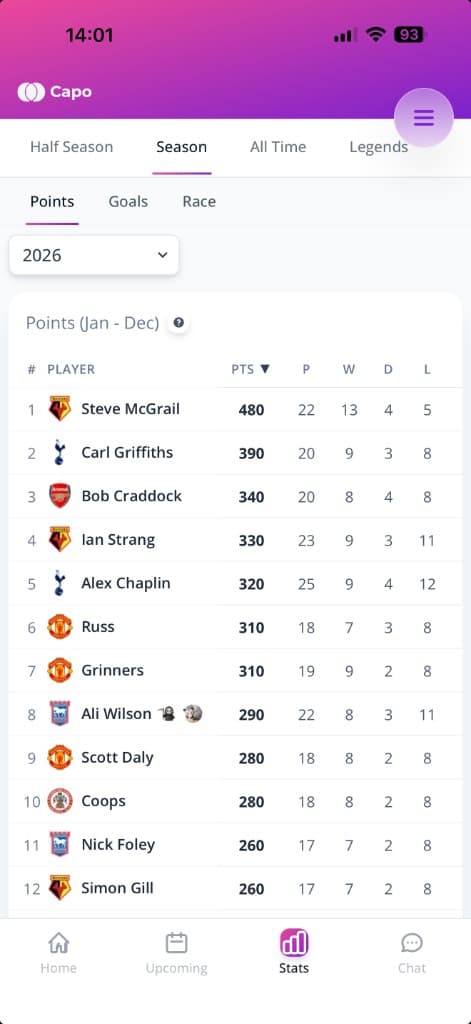
The moment you start tracking, everything shifts. Suddenly there's a table. Someone's top. Someone's bottom. Someone's on a five-game winning streak they won't shut up about. There are rivalries with actual evidence behind them. Bragging rights come with receipts.
Think of it as Fantasy Premier League for your actual mates. Same dopamine hit, except you're the one playing. People who'd normally half-commit to a session suddenly care because they're chasing a personal best or trying not to finish bottom of the table.
It sounds like a small thing. It genuinely isn't. Stats give your group a memory, and a group with a memory behaves differently to one without.
What Stats Should You Track?
You don't need to go full Opta on day one. Start simple and add layers once people are hooked. Here's a sensible progression.
The Basics (Start Here)
If you track nothing else, track these three things:
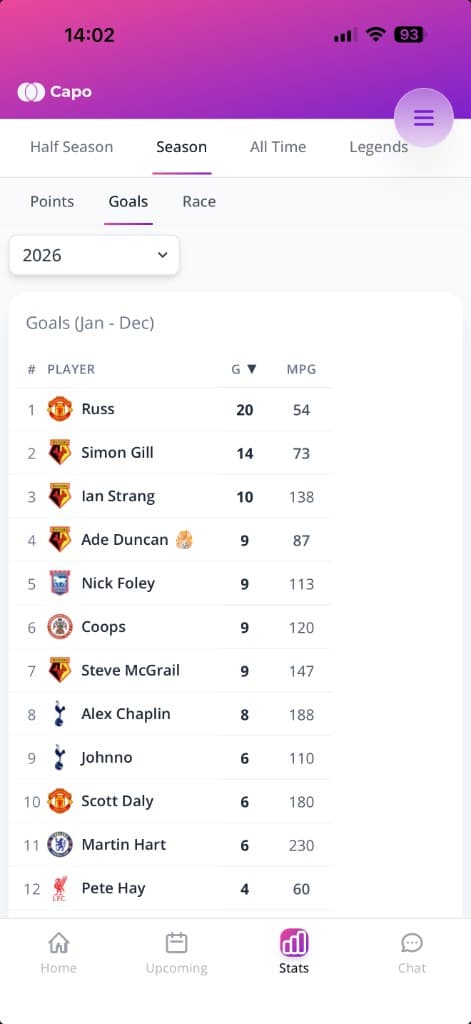
- Goals scored — the universal currency. Everyone wants to know who's top scorer.
- Wins, draws and losses — gives you a league table immediately. Points for a win, fewer for a draw, minus points for a loss. Done.
- Games played / attendance — this one's sneakily important. It separates people who turn up from people who cherry-pick sessions. It also makes "points per game" possible later, which is much fairer than raw totals for anyone who misses a few weeks.
That's enough to create a league table, a top scorer chart and an attendance leaderboard. Three things, and your group chat will never be the same.
Intermediate (Adds Real Depth)
Once the basics are bedded in and people are properly invested:
- Clean sheets — finally, the defenders and keepers get something. Nothing motivates a back line like knowing a clean sheet is being recorded.
- Points per game — more accurate than total points for comparing players with different attendance. The bloke who plays 8 out of 10 and wins 6 is arguably better than the one who plays all 10 and wins 7.
- Win rate — simple percentage. Some people have a knack for ending up on the winning side. This proves it (or disproves it).
- Streaks — winning streaks, scoring streaks, attendance streaks. Streaks create their own stories. "Dave's scored in nine straight weeks" is the kind of stat that writes its own content for your group chat.
Advanced (For the Obsessives)
This is where you go from "we keep a table" to "we're running a proper league":
- Fantasy-style points — result points plus modifiers for heavy wins, heavy losses, and clean sheets. This rewards team performance with extra incentives that shape how people play. It's the stat that causes the most arguments, which is exactly the point.
- Form over last 5 or 10 games — season tables can feel settled by March. Form tables keep things alive because they only care about recent results. The bloke in seventh overall might be top of the form table and suddenly feeling dangerous.
- Personal bests and records — most goals in a game, longest winning streak, highest points-per-game in a season. Records give your group a history. Breaking one feels like a genuine achievement, even if the trophy is just bragging rights in the car park.
The Secret: You Never Need More Data, Just Better Uses of It
Here's the thing people get wrong about that progression: they assume "advanced" means recording more. It doesn't. In fifteen years we have never expanded what we record per match — it's still who played, who won, what the score was, and who scored. Thirty seconds of admin.
Everything else on this page — points per game, win rates, streaks, form tables, minutes per goal, personal bests, all-time records — is derived from those same four inputs. Over the years we didn't collect more data; we found increasingly clever ways to slice what we already had. That's the design principle worth stealing whatever tool you use: keep the inputs trivially small so the admin never becomes a chore, and let the calculations do the work of making it interesting. The moment recording a match takes more than a minute, someone stops doing it, and the whole thing dies.
How to Set Up a Points System
The points system is where most groups either get it right and transform their game, or get it wrong and accidentally reward the wrong behaviour. The exact numbers matter less than the incentives they create. Here's what we use after twelve years of tweaking, and why.
Base Points: Win, Draw, Loss
In Capo, the defaults are 20 for a win, 10 for a draw, and minus 10 for a loss. The loss penalty is important — it means bad results actually cost you something, which keeps games competitive. A simple "3 for a win, 0 for a loss" system has no downside risk, so players who stop coming can't lose ground. With negative loss points, every match matters.
There's also an attendance bonus (10 points) just for turning up and playing. This prevents a weird edge case: once someone has built a lead, the mathematically optimal move is to stop playing. The attendance bonus makes sure participation always has positive expected value.
Heavy Win and Heavy Loss Modifiers
If you win by four or more goals, the base win points are replaced with a higher heavy win bonus (30 points). If you lose by four or more, the base loss is replaced with a heavy loss penalty (minus 20). This is the single most important incentive in the system: even when you're 3–0 down, you're fighting to avoid the heavy loss. And the winning team keeps pushing because the bonus is within reach. Without this, games that get to 3–0 effectively die. With it, 3–0 is where it gets interesting.
Clean Sheet Bonuses
Defenders and keepers get nothing in most scoring systems. Clean sheet bonuses fix that — a win with a clean sheet scores higher than a normal win (30 vs 20). It's a small thing that gives an entire category of player a reason to care about the table.
Why We Don't Count Goals in the Main Table
This is a deliberate choice, and it's the one that makes the biggest difference. Capo's default for goal-scored points is zero. Goals are still tracked — there's a top scorer chart, goals appear in player profiles — but they don't contribute to your league position. Why? Because counting goals in the main table turns football into a solo sport. Players start shooting from everywhere instead of passing. Teamwork goes out the window. The goal hanger who scores three in a 4–3 defeat looks brilliant on paper while actively making their team worse. We tried it both ways over twelve years. Removing goal points from the table visibly improved the quality of the games.
The system is fully configurable per club — you can turn goal points on if your group prefers it. But we'd recommend starting with them off and seeing what happens to the way people play.
Methods for Tracking Stats
Spreadsheets
This is where everyone starts, and honestly, there's no shame in it. Capo's founders ran a Google Sheet for twelve years before building the app. It had tabs for every half-season, auto-calculated tables, and a colour-coded form guide. It was a thing of beauty and also a nightmare to maintain.
Pros: Total control. Free. You can track literally anything if you're handy with formulas. You own the data completely.
Cons: One person ends up doing all the work. It's not great on mobile. Formulas break when someone accidentally deletes a row. And if the spreadsheet person goes on holiday, nothing gets updated. After twelve years of running ours, the biggest lesson was that the system is only as reliable as the one person willing to update it every single week.
Pen and Paper
There's something charming about a handwritten league table on a whiteboard in someone's garage. It works for about three weeks, until someone forgets to bring the notebook or the dog eats it. The problem isn't the writing, it's the durability. Paper doesn't calculate points per game for you, and it definitely doesn't survive a pint being spilled on it.
Verdict: romantic but unreliable. Fine for a casual tournament, not great for an ongoing league.
An App
The obvious advantage is automation. You enter the match result, and everything else updates itself: league table, top scorers, streaks, records, form tables, the lot. No formulas to maintain, no single point of failure, and everyone can check the table on their phone whenever they want.
The disadvantage is that you need to actually use it. If nobody enters the results, the app is just an empty shell. But if your group gets into the habit, it removes all the admin that kills stat-tracking for most groups.
Capo updates all stats, tables, streaks and records automatically the moment you finish a match. One button, everything recalculates. It also triggers over 200 achievements — things like debut goals, underdog wins and secret unlocks that reward moments nobody would think to track manually. If you've spent years babysitting a spreadsheet, it feels almost suspiciously easy.
For a broader look at what's out there, we compared the best five-a-side apps including which ones actually handle stats properly.
Half-Season, Full Season, All-Time: Why All Three Matter
One of the mistakes groups make is tracking stats as one big endless blob. That gets depressing fast for anyone who had a rough start, and it makes it nearly impossible for new players to compete with someone who's been playing for two years.
The solution is layers:
- Half-seasons keep things fresh. Everyone gets a reset twice a year, which means a bad run doesn't haunt you forever. It also creates more title races, more golden boots, more things to win. If your group plays roughly weekly, a half-season of 15–20 games is a good length.
- Full season is the real title. It's the one that settles arguments about who was genuinely the best player that year. Winning a half is nice. Winning the season is proper bragging rights.
- All-time records are the legends table. Most career goals. Highest ever win rate. Longest attendance streak. These are the stats that get mentioned years later. They give your group a genuine history, and they reward loyalty and consistency in a way that seasonal tables can't.
Our version: we run January to December, split at the summer. The half-season gets its own drinks do with prizes for the half-season winners — so someone can win the first half, someone else can win the second, and a third person can still take the overall title. Three trophies out of one season of data. It keeps the whole year alive: a shocking spring doesn't write off your summer, and the August resets produce some of the most competitive football of the year.
Running all three simultaneously sounds like a lot of admin, and with a spreadsheet it genuinely is. With the right setup it's automatic, and it gives your group short-term motivation, medium-term competition and long-term narrative all at once.
Beyond the Table: Rivalries, Picked XIs and Trophy Cabinets
Remember the design principle from earlier — same four inputs, cleverer uses? This is where it pays off properly. Once you've got a few seasons of who-played, who-won and who-scored, the derived stuff gets genuinely good. Here's what those same inputs unlock in Capo, with zero extra admin.
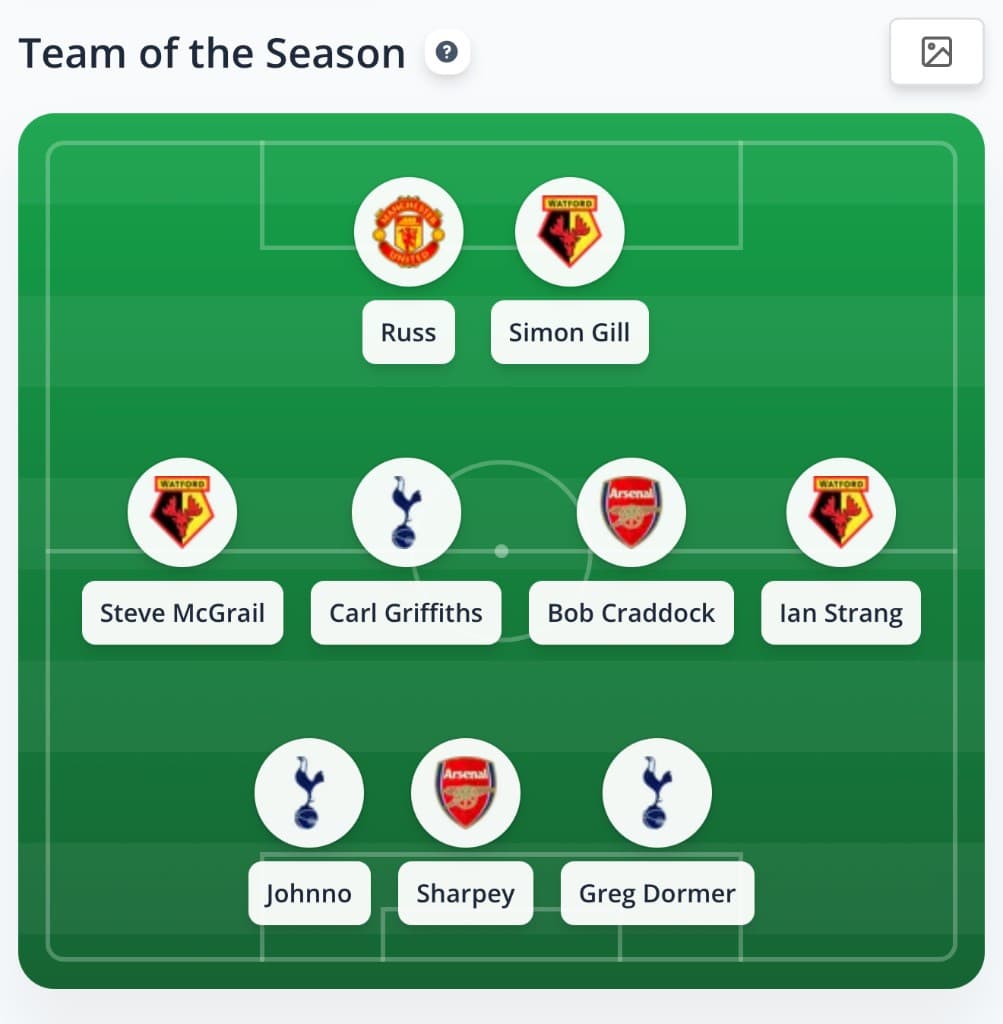
Team of the Season
A full XI, picked by the numbers: most goals up front, fewest goals conceded per game at the back, most fantasy points in midfield. The app doesn't know or care where anyone actually plays — it picks each line by the stat that matches the job, which is half the fun. The perennial goal hanger showing up in defence because his team never concedes is exactly the kind of argument this exists to start.
Crucially, it's live all season. There's a "Team of the Season so far" view that shifts week by week, so people check whether they've broken into the XI — or been bumped out of it — every time results go in. It's a title race with eleven winners instead of one.
Head-to-Head: Settle the Argument
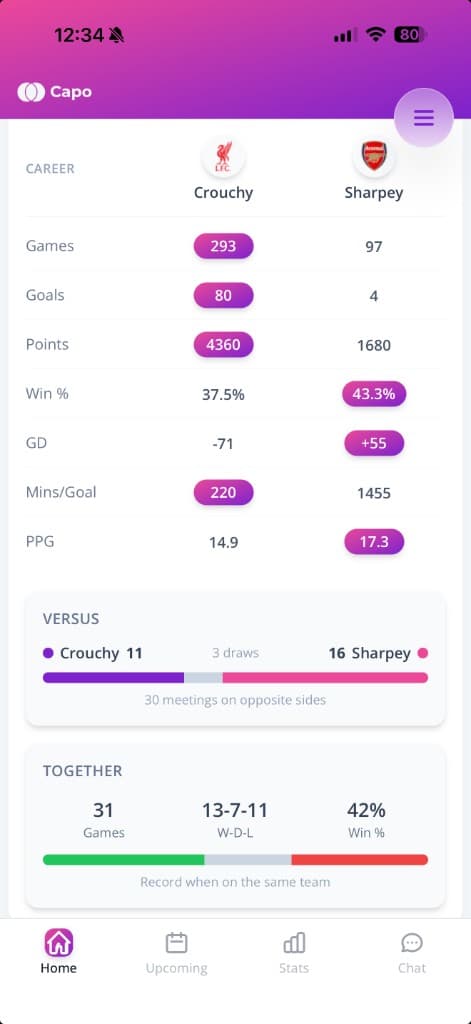
Every group has one running argument that never gets resolved. Ours have been settled for good by the compare screen: pick any two players and see their careers side by side — games, goals, points, win rate — plus their record against each other and their record together. That last one is sneaky-good: it turns out some pairs win nearly everything when they're on the same side, and knowing that changes how people lobby for teams.
Your Nemesis (and Your Favourite Opponent)
Player profiles show a Rivals section: the opponent you struggle against most — your nemesis — and the one you seem to beat every time. "Won 6 of 23 against him" is a brutal little sentence to find on your own profile, and it creates a fixture-within-the-fixture every time the two of you end up on opposite sides. Fifteen years in, some of our rivalries have more history than actual derbies.
The Trophy Cabinet
All those half-season titles, golden boots and Man of the Match awards need somewhere to live. Each player's profile has a trophy cabinet — season titles, top scorer awards, career award counts — so the honours from 2019 don't vanish into an old spreadsheet tab. It's the difference between winning something and being able to point at it in the pub four years later.
And when a season wraps up, all of it — your numbers, your best teammate, your nemesis, whether you made the Team of the Season — gets rolled into a personal end-of-season recap for every player. We've written about that separately: see Season Wrapped for your five-a-side.
Why Stats Turn a Kickabout Into a Story
Without stats, every week is a standalone episode. Fun enough in the moment, forgotten by Tuesday. With stats, your game becomes a series with connected plots. There's a title race that builds over months. There's a scoring streak that someone's desperate to keep alive. There's a form table that gives the bloke in seventh something to be excited about. It's not just "did we win tonight" — it's a season-long narrative that everyone's invested in.
We're all over 35 in our group. Nobody's getting scouted. But we're competitive, and the table gives you something to aim for every week beyond just turning up and having a run-around. It makes the games feel like they matter. You can go for a jog by yourself, but people prefer to track their runs and share them — that's why Strava works. Capo is the Strava of casual football. Same idea: take something you already do for fun, add data, and suddenly it means more.
It also gives you something tangible for the social side. End-of-season awards at the Christmas curry — best player, golden boot, most improved — all backed up by actual stats. It's harder to argue with the numbers, and it gives the group shared memories that carry over from one season to the next.
Stats also help with balancing teams. When you know everyone's win rate and points per game, you've got actual data to work with instead of guessing who should be on which side. And if you're managing a tiered squad, stats give players at every level something to compete for — even the casuals who only play a few games a season.
Frequently Asked Questions
What's the best app for tracking five-a-side stats?
It depends what you need. Some apps do basic goal tracking. Others handle full league tables with configurable points, form guides, streaks and records. We've done a full comparison of five-a-side apps if you want to see what each one offers. The short version: look for one that automates calculations and handles seasons, not just individual games.
How do you set up a league table for five-a-side?
Decide on your points system — win, draw, loss values plus any modifiers for heavy results and clean sheets. Record who played in each match, which side won, and who scored. From there, a league table is total points ranked highest to lowest, with points per game as a tiebreaker for players with different attendance. You can do this in a spreadsheet or use an app that does it automatically. The important thing is consistency: record every match, not just the ones you remember.
Should we do seasons or just track all-time stats?
Both. Seasons (ideally split into halves) keep the competition alive because everyone gets a fresh start. All-time stats give your group history and long-term bragging rights. Running only all-time makes it impossible for newer players to compete, and running only seasons means nothing carries over. The best setup uses both.
For a full walkthrough of setting up your group from scratch, start with our guide to organising a five-a-side. And if you want to see how awards and voting can add another layer on top of stats, have a look at how voting and awards work.
Capo was built by a group that tracked five-a-side stats in a spreadsheet for twelve years before deciding there had to be a better way. If your group is ready to graduate from manual tables to something that just works, see how it works.