How to Pick Fair Teams for Five-a-Side (Without the Arguments)
Ian has organised the same weekly football game since January 2011 — dealing with no-shows, late payments, and unbalanced teams long before building Capo to sort it out.
Why Team Balance Matters More Than You Think
Everyone has been in a five-a-side where one team is clearly better and the game is effectively over within five minutes. It's boring for the side that's cruising and miserable for the side getting taken apart. The scoreline runs away, people stop trying, and by the end you've paid seven quid for 40 minutes of going through the motions. Picking fair teams for 5-a-side is the single most common argument in weekly football with mates — and there are better ways to do it than letting the loudest person in the car park decide.
Lopsided games are also a slow poison for attendance. People don't stop coming because of one bad night. They stop coming because three out of the last four weeks felt like a waste of time. And the organiser gets it in the neck either way: pick the teams badly and it's your fault, try to fix it and suddenly you're playing favourites. It's a thankless gig.
The truth is that team balance is the single biggest factor in whether people enjoy the game. A close, competitive match where the result is in doubt until the last few minutes is better than a 12-3 hammering regardless of which side you're on. Getting the teams right isn't a nice-to-have. It's the thing that keeps your group coming back.
If you want the full picture on running a regular game, our guide to organising a five-a-side covers everything from finding a pitch to keeping the group alive. But right now, let's focus on the bit that causes the most arguments: picking the teams.
Manual Methods (And Their Problems)
Captains Pick
The classic. Two captains, alternating picks, just like the school playground. It's fast, everyone understands the format, and it usually produces vaguely sensible teams because the captains know who's good.
The problem is everything else. Being picked last is genuinely rubbish, and everyone knows it. Even grown adults feel it. There's also the politics: the captain picks his mate first even though his mate is average, or two decent players refuse to be on the same side, or the same bloke ends up captaining every week because nobody else can be bothered with the grief.
Captains picking works best when the group is tight-knit, everyone's roughly the same level, and nobody takes it too seriously. The moment you have a clear skill gap or any kind of ego involved, it gets messy.
Random (Bibs Out of a Bag)
Chuck five light bibs and five dark bibs in a bag. Everyone pulls one out. Done. It's the fastest possible method and it has one massive advantage: nobody can accuse anyone of bias. The bag doesn't have mates. The bag doesn't play politics.
The downside is obvious. Random is random. Sometimes you end up with the four best players on one side and a team of goalkeepers on the other. Over enough weeks it theoretically evens out, but nobody remembers the theoretical average. They remember the 9-1 last Thursday.
Random works for groups where the skill level is genuinely flat, or for groups that just want zero hassle and can live with the odd blowout. If your group has a wide range of abilities, random will produce too many bad games.
"Strong-Weak" Pairing
This is the step up from random. Rank the players roughly from best to worst, then deal them out: best player to Team A, second best to Team B, third best to Team B, fourth to Team A, and so on in a snake pattern. In theory, this spreads talent evenly.
In practice, the question is who decides the ranking. The organiser? Based on what? Their gut feeling? Last week's performance? Reputation from three years ago? The moment someone finds out they've been rated below someone they think they're better than, you've got a diplomatic incident on your hands.
Strong-weak pairing is a decent method if you can get the rankings right without it becoming personal. The problem is that manual rankings are always subjective, always contested, and usually out of date.
Fixed Positions
Some groups try to balance by position: make sure each team has a defender, a midfielder, an attacker, and so on. This sounds logical if you're thinking about 11-a-side, but five-a-side is too fluid for it. On a small pitch, everyone ends up everywhere. The bloke you put in "defence" is in the opposition box within two minutes. The striker is tracking back. Positions barely exist.
The exception is goalkeepers, which we'll cover properly below. But for outfield players, trying to balance by position in five-a-side is solving a problem that doesn't really exist.
How Stats-Based Balancing Works
All the manual methods share the same weakness: they rely on someone's opinion of who's good. Opinions are sticky. Once someone gets labelled as "one of the better players" they tend to keep that reputation long after their form has dropped off. And the quiet player who's been consistently solid for months never gets the credit because nobody's actually tracking it.
Stats-based balancing flips this. Instead of reputation, you use actual recent performance data. Who's been winning? Who's been contributing? Not based on one flashy goal three weeks ago, but on a rolling picture of form.
The key word is "recent". A good balancing system weights recent matches more heavily than older ones because form matters more than historical ability. Someone who was brilliant six months ago but has barely played since shouldn't carry the same rating as someone who's been turning up and performing every week.
The other important bit is that stats-based balancing considers more than just goals. Goals are the most visible stat, but they're not the whole picture. Wins, contributions to close games, consistency across matches: all of these tell you more about a player's actual impact than a raw goal tally. The bloke who scores hat-tricks in blowouts but disappears in tight games isn't necessarily your best player.
There's a useful side-effect too: when team selection is based on data that everyone can see, the arguments mostly go away. It's harder to claim the teams are unfair when the algorithm used the same objective numbers for everyone. The "who made these teams?" grumbling drops off because the answer isn't a person with potential biases. It's maths.
This is how Capo's AI team balancing works. It uses form-weighted player ratings derived from actual match data to generate balanced sides. No opinions, no politics, just performance. If you're curious about what's happening under the hood, the write-up on the genetic algorithm behind it goes into the technical detail.
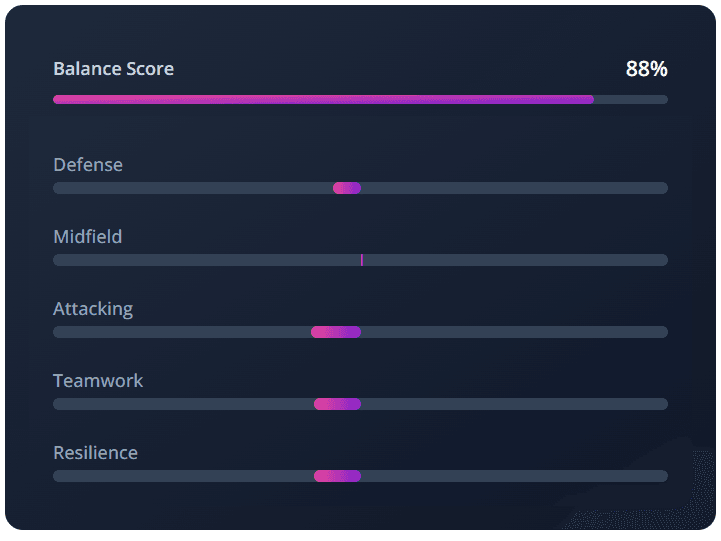
Of course, stats-based balancing only works if you're actually tracking stats and keeping a league table. Which brings its own benefits well beyond team selection.
Balance by Rating: How an Organiser Actually Thinks
The first approach to algorithmic balancing mirrors how a good organiser already picks teams in their head — just done systematically and without the politics. If you've been running a game for any length of time, you'll recognise the thought process. The algorithm just makes it explicit.
Step 1: Start With Defenders
Not necessarily the "best" defenders on paper, but the players most likely to actually stay back during the game. There's a difference. You might have someone rated 10 out of 10 at defending, but if they wander forward every time the ball goes past halfway, they're not really your defender. You want the players who will stay back. Section those off and balance them between teams on skill, speed, and physicality.
Step 2: Then Goal Scorers
Both teams need a goal threat. Every group has the players who are most likely to nick one — the poachers, the clinical finishers, the bloke who somehow scores from nothing. Identify them and split them evenly. A team with no goal threat is a team that's going to lose, no matter how solid they are at the back.
Step 3: Then Midfielders
Everyone else. Balance on technique, control, and athleticism within this group. These are the players who knit the team together, and getting them evenly matched is what stops one side dominating possession while the other chases shadows.
Step 4: Apply Teamwork Factor
You don't want all the lone wolves on one team. Every group has the Head-Down Kid — the one who never looks up, never sees the pass, and dribbles into three players every time. Spread those players out. Balance them against the unselfish passers who make everyone around them better. A team of five individuals who never find each other will lose to a team of five average players who actually combine.
Step 5: Apply Temperament Factor
This is the one most people miss. Some players' heads drop when they go behind — the MIA types who go missing when it matters. You don't want a whole team of them, because the moment they concede two quick goals, it's over. They switch off, stop running, and the game dies. Balance those players against the clutch performers — the ones who drag you back into games when you're 4-2 down with five minutes left.
Step 6: Find the Best Combination
The algorithm evaluates every possible team combination across all these factors — positional strength, goal threat, teamwork, temperament — and picks the split that produces the closest match. It's a brute-force search through every permutation, which sounds computationally intense but is perfectly manageable for five-a-side squad sizes.
Before Capo existed, the other organiser of our weekly game — Alex Chaplin, 645 appearances and counting — did all of this manually in his head. The group called it the "AL-gorithm" (because his name's Alex) and he got grief every single week about his team picks.
"Like directing a film," is how Alex describes those years. "You want the audience to leave feeling happy — and that means a close game, a nailbiting movie. I'd feel a lot of pressure to make sure the games felt balanced." That pressure is the part nobody warns you about. Whoever picks the teams owns every blowout, personally, whether it was their fault or not.
His most honest admission: "Before the app, I used to dread getting back from holiday, because they'd all tell me how much closer the games were when someone else was balancing the teams." Fifteen-plus years of picking teams, and the group's highest praise was reserved for the weeks he wasn't there.
Now the app does it, the arguments mostly stop. If the teams are wrong, people blame the algorithm rather than a person — and it generally produces close, fair games week after week.
There's a practical bonus too: when someone drops out last minute, Capo automatically rebalances and republishes the teams. No frantic group-chat reshuffling, no one person trying to rejig sides on the drive to the pitch. If you've ever dealt with the chaos of late dropouts, you'll know how much time that saves — it's one of the biggest headaches of managing a five-a-side squad.
The key insight is that this approach works because it mirrors real-world team-picking logic. Every experienced organiser subconsciously thinks about positions, personality, and ability when choosing sides. The algorithm just does it systematically, considers every combination instead of the first one that looks right, and removes the politics entirely. The organiser sets up player ratings once, and the system handles the rest.
Balance by Performance: Let the Data Decide
Rating-based balancing is powerful but it requires setup — someone has to rate every player across multiple attributes, and those ratings need maintaining as players improve or decline. Not every organiser wants that overhead. The performance-based approach is the zero-friction alternative: it uses actual match data to work out who should be on each team, with no manual input at all.
How It Works
The system tracks two core metrics from your match history: a power rating based on overall match performance (wins, points, contributions) and a goal threat score based on scoring record. Both use an exponentially weighted formula that gives more importance to recent matches without throwing away older data entirely. Think of it as a rolling form guide where last week counts more than last month, and last month counts more than last year — but nothing is ever completely forgotten.
This handles one of the trickiest problems in team balancing: gradual decline. A player who was brilliant two years ago but has been fading doesn't carry the same inflated rating forever. Their numbers adjust naturally as newer, weaker results carry more weight. Equally, a player on a hot streak doesn't suddenly get massively over-rated from one purple patch — the historical data provides a stabilising anchor.
No Setup Required
The beauty of this method is that there's nothing to configure. If you're already recording match results and scorers in the app, the performance ratings build themselves in the background. Once a player has around ten games of history, the system has enough data to produce reliable ratings. From that point, balanced teams are available at the tap of a button.
New players or guests who don't have enough history aren't left out — they get assigned a sensible default rating based on the league average until they've played enough matches for their actual ability to show through. It's not perfect for the first few weeks, but it's a lot better than guessing.
Which Method Should You Use?
Both approaches produce fair teams. The trade-off is nuance versus convenience:
Rating-based balancing is more nuanced. It factors in positions, personality traits like teamwork and temperament, and gives the organiser fine-grained control. But it requires manual setup and occasional maintenance as your squad changes. It's the right choice for groups with a stable core who want the tightest possible balance.
Performance-based balancing is friction-free. It needs no setup beyond recording your results, adapts automatically as players' form changes, and handles squad turnover without the organiser lifting a finger. It's ideal for groups who want fair teams without any admin overhead, or for new groups who haven't rated their players yet but have a few weeks of match history.
In Capo, both options are available and the organiser chooses whichever suits their group. Some start with performance-based balancing because it's instant, then switch to rating-based once they've taken the time to rate their squad. Others stick with performance forever because the results are good enough and the zero-effort appeal is hard to beat.
What Actually Happened When We Switched
Our group has recorded every match since January 2011 — 736 matches and 5,081 goals at the last count — so we don't have to guess whether algorithmic balancing works. We can measure it.
The test case arrived in late 2022, when a genuinely dominant player joined: Pete Hay, the kind of signing that breaks a casual game. Whichever side Pete was on started winning by an average of +0.90 goals per game, and blowouts doubled. This is exactly the situation manual balancing can't fix — the AL-gorithm could spread ten roughly comparable players, but there's no clever way to hand-pick around one player who's simply better than everyone else. That problem is what pushed us to build the algorithmic balancer in the first place.
The results across the first 37 algorithm-balanced matches:
| Metric | Manual picking | Algorithm |
|---|---|---|
| Pete's team advantage | +0.90 goals/game | +0.44 (halved) |
| Pete's win rate | 52.4% | 48.1% |
| Pete's own goals/game | 1.33 | 1.33 (unchanged) |
The last row is the interesting one. The algorithm didn't nerf the best player — he scored at exactly the same rate. It rebuilt the teams around him so his brilliance stopped deciding the result on its own. That's what balancing is actually for: not dragging good players down, but making sure the other nine matter too.
Thirty-seven matches is a promising sample, not proof — we're honest about that. The full dataset, including the ageing curves, the streaks, and what fifteen years of Thursdays does to a scoring rate, is in our deep-dive into the group's data.
What About Goalkeepers?
Goalkeepers are a special case and most groups handle them badly. The usual approach is to throw keepers into the general mix and hope for the best, which means one team sometimes ends up with the only decent goalkeeper and a massive advantage before a ball is kicked.
The smarter approach is to fix your keepers first, then balance the outfield players separately. If you've got two regular keepers, assign one to each side before doing anything else. If you've only got one willing keeper and the other team rotates, that's a different kind of balancing challenge, but at least you've acknowledged it rather than pretending goalkeeping doesn't matter.
In Capo, goalkeepers are excluded from the outfield balancing algorithm entirely. They're assigned first, then the outfield balance is calculated without them skewing the numbers. It sounds like a small detail but it makes a genuine difference to how fair the teams feel.
The "Close Enough" Principle
Here's something worth being honest about: perfectly balanced teams don't exist. Football has too many variables. Someone has an off night. Someone plays out of their skin. One team clicks and the other doesn't. You can get the teams as close as the data allows and still have a 7-2 because one side couldn't string three passes together.
The goal isn't perfection. It's consistency. If most weeks the game is competitive and the result feels like it could go either way, you're winning. The odd blowout is fine. Football is unpredictable and that's part of why people love it. What you want to avoid is a pattern where the same players are always on the strong side and the same players are always getting battered.
The best sign that your team selection is working isn't that every game ends 5-4. It's that close scorelines are the norm rather than the exception. If you find that most matches are within a couple of goals, whatever method you're using is doing its job. If you regularly see five-goal margins, something needs to change.
And if you're not sure what your scorelines actually look like over time, that's a sign you might benefit from tracking your results properly.
FAQ
Is there an app that balances five-a-side teams?
Yes, a few. Most of them let you manually rate players and then split them into balanced sides. Some go further and use actual match data to generate ratings automatically. We've compared the main options here. Capo is one of the few that does the rating and the balancing automatically based on real performance data rather than asking the organiser to guess who's a 7 out of 10.
How do you make five-a-side fair with mixed abilities?
Mixed ability groups are actually where balancing matters most. The trick is spreading the stronger players evenly and making sure the weaker players aren't all concentrated on one side. Strong-weak pairing does this manually. Stats-based balancing does it automatically and tends to be more accurate because it uses data rather than gut feel. If your group has a big skill range, any method that uses actual performance data will produce fairer teams than any method based on opinions.
Should captains pick teams for five-a-side?
Captains picking is fine for groups where everyone is mates, the skill gap is small, and nobody takes it too personally. Once you have regular players of noticeably different levels, or anyone who gets visibly bothered about being picked late, it starts causing more problems than it solves. If you want to keep the social element of captains picking without the downsides, one approach is to let captains choose from pre-balanced pools rather than the full group. That way the teams are already roughly even and the captains are just deciding who they want to play with.
Fair teams make better games, and better games keep people coming back. If your current method is causing more arguments than it's worth, Capo's AI balancing takes the politics out of it and lets the data do the picking. You can see exactly how the balancing screen works in our complete setup walkthrough.