
AI Team Balancing
Balancing casual football teams is a nightmare — and someone always complains.
Capo takes this headache away with one-click team balancing that actually works.
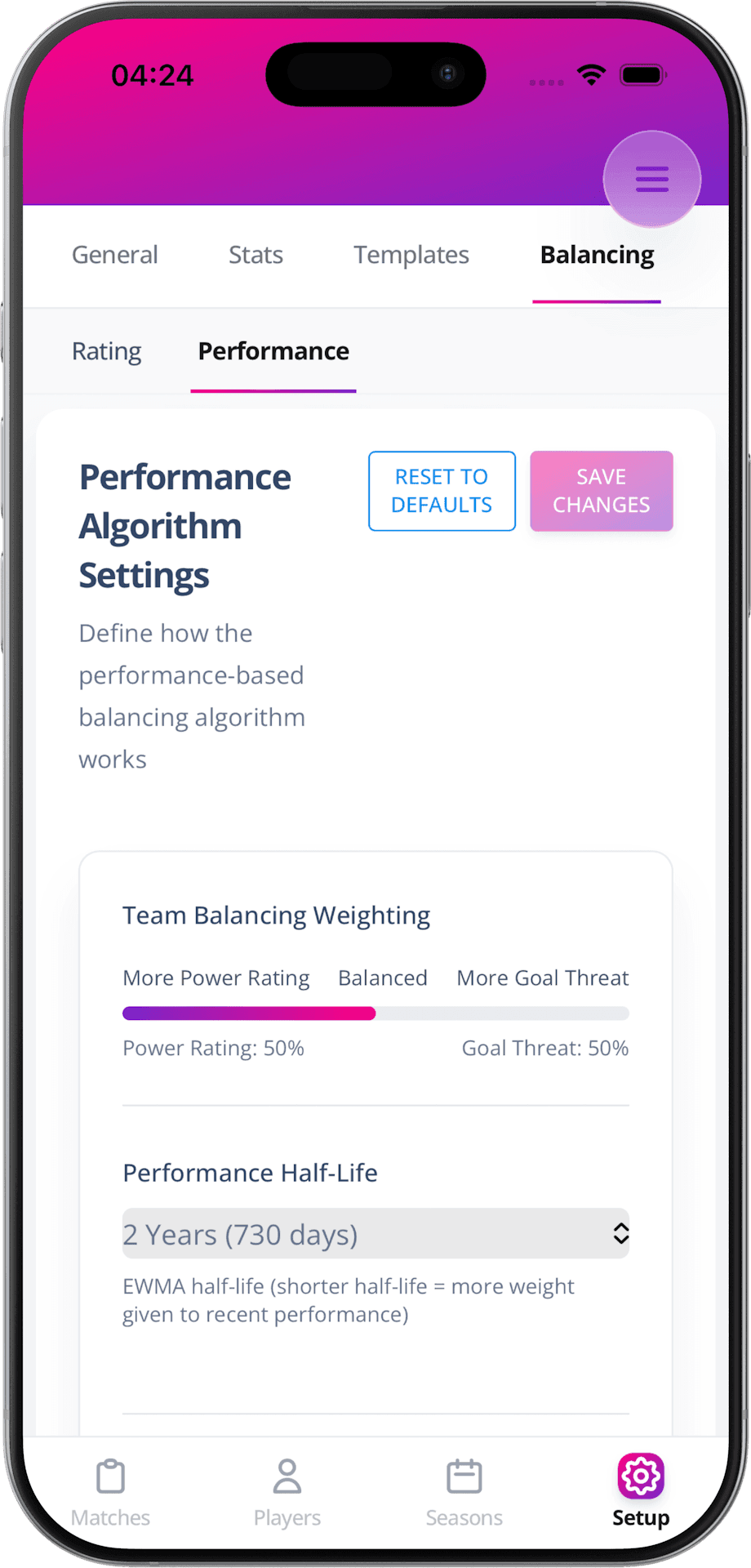
Performance Balancing
Capo automatically analyses past games, win rates, goal-scorers and fruitful player combinations — then builds teams designed to make the match as close as possible.
It weights recent form more heavily than ancient history. We all decline with age, and Capo knows it.
Ability Balancing
Want more control? Rate your players and Capo balances teams the way a good organiser actually thinks: first, who'll genuinely stay back and defend (not just who's skilled — who'll actually do it). Then who's your goal threat. Then the midfield. Then it adjusts for temperament and teamwork — spreading the lone wolves who never pass and the players whose heads drop when losing.
We used to call this the "AL-gorithm" — named after co-organiser Alex, who did it all in his head and got grief every single week. Now the app does it. The arguments mostly stopped.
Fantasy League Balancing
If you're using the leaderboard to track fantasy points, Capo will soon be able to balance teams to keep the title race tight.
Handles the awkward stuff automatically
Fixed Goalkeepers
Got designated keepers? They're locked in and excluded from outfield balancing — no more skewed ratings from "injured mate in goal" situations.
Uneven Numbers
11 players? 9? Capo adjusts the balance calculation automatically — fair teams even when the numbers don't divide nicely.
Last-Minute Dropouts
Someone pulls out an hour before kickoff? Capo rebalances and republishes the teams instantly. No manual reshuffling, no panic.
Balance Score
See a tornado graph of relative team strength across different factors — share it in the chat to prove why nobody can complain.
How the balancing actually works
Both modes are trying to replicate what a good 5-a-side organiser actually does in their head — just without the thirty minutes of deliberation and the inevitable argument afterwards. The logic behind each mode maps directly to how you’d think about it on the touchline.
Balance by Rating
You rate the players — Capo does the maths
Balance by Rating works from day one — you rate your players yourself, and the algorithm uses those ratings to build the fairest teams it can find. Some organisers prefer this mode permanently because they know their players well and like the control.
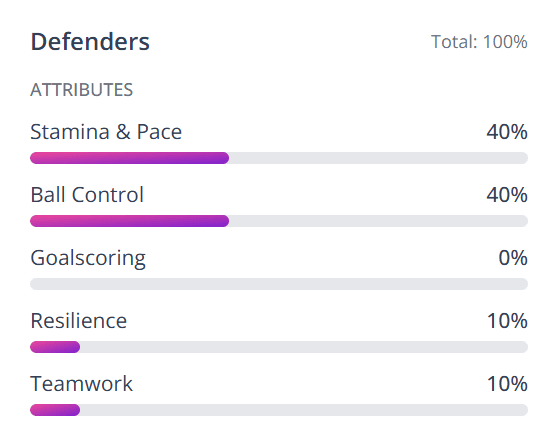
The first thing it asks is: who will actually stay back and defend? In casual 5-a-side, the biggest source of lopsided games isn’t raw ability — it’s one team having no one willing to sit at the back while the other has two players who genuinely track back. So the algorithm looks first at willingness to defend, and picks the players most likely to actually do that job. The number of defenders it selects depends on the formation template for your game size — each team size has a standard template built in, which you can adjust in admin settings if your group plays a different shape.
1. Defenders first
Picks players who’ll genuinely track back — not just who’s skilled, but who’ll actually do it.
2. Then attackers
Goal threats identified by scoring ratings. Everyone else fills midfield.
3. Then balance
Shuffles within each position group until attribute totals are as close as possible across both sides.
Within each position group, it’s balancing across multiple attributes at once: physical ability, technical control, teamwork and resilience. The relative importance of each attribute is configurable in admin settings — the defaults are sensible for most casual groups, but if your game has a particular character you can adjust them. The algorithm will spread the players who bomb forward and never track back, and the players whose heads drop when losing, evenly across both teams.
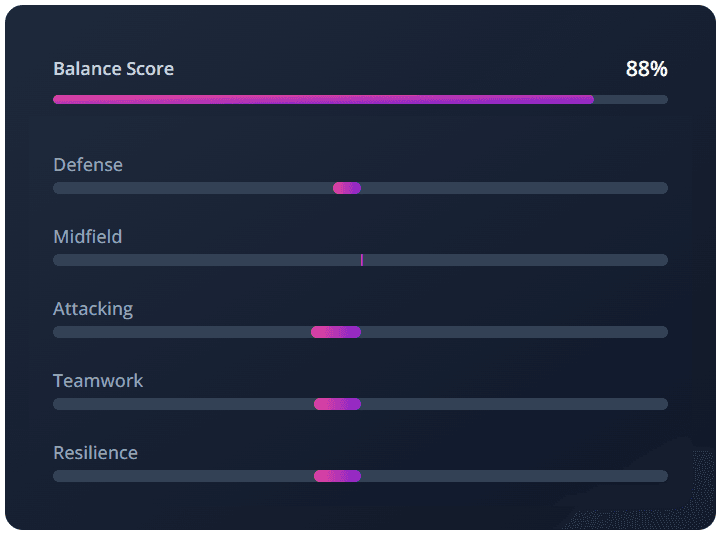
The balance score shows how evenly matched the teams are across every dimension.
Balance by Performance
Let the data do it — no ratings to maintain
Instead of ratings you’ve assigned manually, this mode works from two metrics Capo calculates automatically from your match history — the same Power Rating and goal threat figures you can see on each player’s profile. It works from as few as five games, but gets sharper the more data it has.
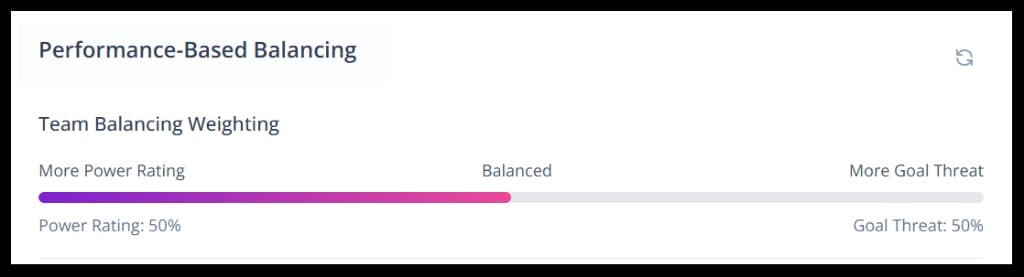
Power Rating reflects how well a player has been performing overall: win rates, goal contributions and match outcomes while they were on the pitch. Goal Threat measures how likely they are to score, independently of whether their team won. Capo combines the two, and you can set the balance between them in admin settings — it defaults to 50/50, but if you care more about keeping goal output even than overall power, you can shift that weighting.
Recency weighting
The recency weighting is what makes this mode particularly useful for long-running groups. It can look at years of match data and still give much more weight to recent games than old ones — so if someone’s form has dropped, or a newer player has been flying lately, the teams reflect that automatically. You don’t need to remember to update anyone’s rating.
Which one should you use?
Rating mode suits you if…
- •You’re new to Capo with no match history yet
- •You know your players well and want fine-grained control
- •You like maintaining the ratings yourself as the group evolves
Performance mode suits you if…
- •You’ve played five or more games and want it hands-off
- •You want the teams to adjust to form automatically
- •You don’t want to keep anyone’s ratings up to date
Some organisers use Rating mode indefinitely because they know their players and like the control. That works perfectly well. The key difference is maintenance: Rating mode gives you fine-grained control but you need to keep the ratings current. Performance mode is self-updating, but it needs match data to work from. Either way, the organiser is no longer the one who picked the teams — the app is. Which means the arguments mostly stop.
Result:
Less admin. Closer scorelines. Fewer player strops.