Why WhatsApp Groups Are Terrible for Organising Five-a-Side Football
Ian has organised the same weekly football game since January 2011 — dealing with no-shows, late payments, and unbalanced teams long before building Capo to sort it out.
Everyone Uses WhatsApp. That Doesn't Mean It Works.
If you run a weekly five-a-side, there's a very good chance your entire operation lives inside a WhatsApp group. And honestly, that makes sense. Everyone already has WhatsApp. There's no sign-up, no app to download, no awkward "can everyone please check their email" moment. You create a group, add the lads, and you're away. But if you're here, you've probably realised that WhatsApp isn't a football organiser app — and you're looking for a better alternative to WhatsApp for organising your weekly 5-a-side with mates.
For a group of six or seven mates who all turn up every week without fail, it's probably fine. The problems start when the group gets bigger, when attendance gets less reliable, and when the person organising it starts spending more time scrolling through memes looking for RSVPs than actually playing football.
WhatsApp is brilliant at what it was built for: chat. Group banter, quick messages, sending clips of that goal your mate thinks was better than it actually was. The trouble is that somewhere along the way, most football groups started using it for everything else too. RSVPs, payments, team announcements, availability, waitlists. And for those jobs, it's genuinely terrible.
Not terrible as in "a bit annoying". Terrible as in "the organiser is doing unpaid admin for fifteen people every single week and nobody notices".
The Problems
"Who's In?" Scroll Hell
Every week, someone posts "Who's in for Thursday?" and then the chaos begins. Three people reply straight away. Then someone sends a meme. Then two more people reply to the meme. Then someone says "maybe, depends on work". Then someone else quotes the meme and adds their own. Buried somewhere in there, a fourth person has said they're playing, but good luck finding it.
By Wednesday evening the organiser is manually scrolling through 40-odd messages trying to piece together who actually said yes, who said maybe, and who hasn't replied at all. It's like doing a census using Post-it notes stuck to a moving bus.
The bigger the group, the worse it gets. Once you pass ten or twelve people, the signal-to-noise ratio drops off a cliff. If you're running a group of 15 to 20 players and trying to fill 10 spots each week, you're essentially running a small logistics operation inside a tool designed for sharing photos of your dinner.
No Waitlist, No Capacity
Say you need 10 for Thursday. Twelve say yes. Now what? You can't tell people 11 and 12 that they're on a waitlist because there isn't one. You either have the awkward conversation ("sorry mate, too slow") or you try to squeeze 12 into a 10-player game and hope nobody minds.
Then on Thursday afternoon, someone drops out. Now you need to message back into the group and hope one of the standbys is still free. Except they've already made other plans because you told them the game was full four hours ago.
There's no overflow, no automatic backfill, no way to handle this without the organiser personally managing every single change. It's a spreadsheet job being done through a chat window, and it falls apart every time someone changes their mind. If no-shows are already a problem in your group, WhatsApp makes them worse because there's no structure around the dropout process.
Money Conversations in Group Chat
Nothing kills a group chat vibe faster than "Can everyone send me five quid for the pitch?" posted to a group of 15 people. Half of them ignore it. Three reply "done" (but haven't actually paid). Two send it to the wrong person. And the organiser is now tracking payments in their head, their bank app, and the chat simultaneously.
The problem isn't that people are tight. It's that asking for money in a group chat is awkward by design. Nobody wants to be the one publicly chasing a fiver, and nobody wants to be the one publicly reminded they haven't paid. So the organiser either chases privately (doubling the admin) or lets it slide (and quietly subsidises everyone's football). Neither is sustainable. There's a reason collecting money for five-a-side is one of the most hated parts of organising.
Team Announcements Get Lost
You've spent ten minutes working out balanced teams. You post them at 6pm. By 6:15 someone's sent a voice note about something unrelated and the teams are 30 messages up the chat. Three people arrive at the pitch not knowing which side they're on. Someone insists they were on the other team. The organiser sighs deeply and does it again on the whiteboard.
WhatsApp has no concept of a pinned result or a team sheet. Everything is just another message in a stream that flows relentlessly forward. Important information has the same visual weight as someone replying "haha" to a joke from three hours ago.
No Memory
Who won last week? What was the score? Who scored? How many games has Dave actually played this season? Nobody knows. WhatsApp doesn't remember anything because it's not designed to. Every week starts from zero.
This might sound trivial, but it's actually a big part of what keeps a regular game feeling like it matters. Keeping stats and a league table gives the group something to talk about beyond last night's telly. It turns a weekly kickabout into something with a bit of continuity. WhatsApp can't do any of that.
What WhatsApp IS Good For
Here's the thing: none of this means you should kill the group chat. Don't. The WhatsApp group is where the banter lives. It's where someone posts a clip of a Premier League howler at 11pm on a Tuesday. It's where you wind up the bloke who missed a sitter last week. It's where the in-jokes accumulate over years.
That stuff is genuinely important for keeping a group together. A football group that only communicates through admin notices is a football group that's going to fizzle out. People stick around because they like the people, and the chat is where that happens.
WhatsApp is also great for quick, one-off messages. "Pitch is waterlogged, we're at the other venue." "Running 10 mins late." That sort of thing. Instant, everyone sees it, no fuss.
The mistake is using WhatsApp for both the social side and the organising side. They need different tools because they're different jobs. Chat is freeform and messy by nature. Organising needs structure. Cramming both into one place means the organising always loses.
Get the split right and the two actually feed each other. Here's what our group chat looks like after a Thursday game — the app posts the full stats drop into WhatsApp, and the chat takes it from there:
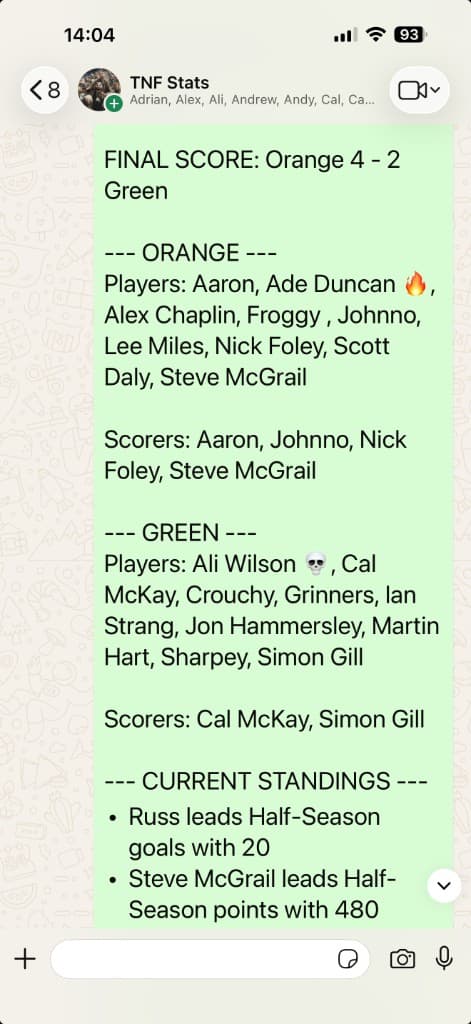
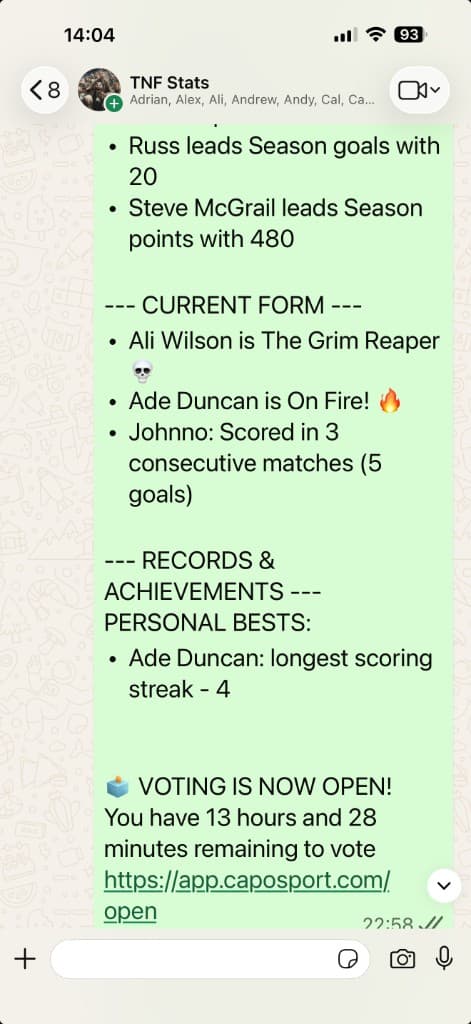
Notice what's happening there: WhatsApp isn't doing any organising. No "who's in?", no chasing, no scrolling for the team sheet. It's doing what it's brilliant at — carrying the reaction. The structured stuff (bookings, teams, stats, voting) lives in the app; the fallout lives in the chat.
What to Use Instead (for the Organising Bit)
The answer isn't to replace WhatsApp. It's to stop asking it to do things it was never built for. Keep the group chat for chat. Use something purpose-built for the admin: RSVPs, payments, team selection, stats.
There are a few options out there and they all take slightly different approaches. If you want a proper comparison, we've written one up here. The short version is: look for something that handles availability, waitlists, payments, and teams without requiring you to manually manage any of it.
That's essentially why we built Capo. It handles the organising side so your WhatsApp group can go back to being what it's actually good at: a place where your mates talk rubbish to each other. RSVPs with automatic waitlists, in-app payments (available in 30+ countries via Stripe), team balancing, stats, the lot. The organiser stops being an unpaid admin and the group chat stays fun.
If you want a deeper look at what goes into running a five-a-side properly, our complete guide to organising a five-a-side covers the full picture from finding a pitch to keeping the group alive long-term.
FAQ
Should I start a separate WhatsApp group for football admin?
People try this and it sort of works for about a fortnight. Then someone posts banter in the admin group, someone else posts availability in the main group, and within a month you're back to the same mess but now spread across two chats. The fundamental issue isn't which group the information is in. It's that WhatsApp treats every message the same: a line in a stream. You need something that actually structures availability, payments, and teams as separate, trackable things rather than messages that scroll away.
Can I use WhatsApp polls for five-a-side RSVPs?
You can, and it's better than the "who's in?" free-for-all. At least you get a count. But polls don't handle capacity (what happens at player 11?), they don't handle dropouts (no automatic waitlist backfill), and they don't connect to payments. If your group is small and attendance is reliable, a poll might be enough. If you regularly deal with maybes, late changes, and chasing money, you'll still end up doing most of the admin manually.
Your WhatsApp group isn't the problem. Asking it to be your booking system, payment tracker, and team sheet all at once is. Let it do what it does best, and hand the organising to something that was actually built for it. If you want to see exactly how Capo handles all of it, our complete setup walkthrough covers the whole thing from first match to full automation.